

By Mary Cate Connors, Humanities Council
“What does it mean to enter a poem that stands the test of time?”
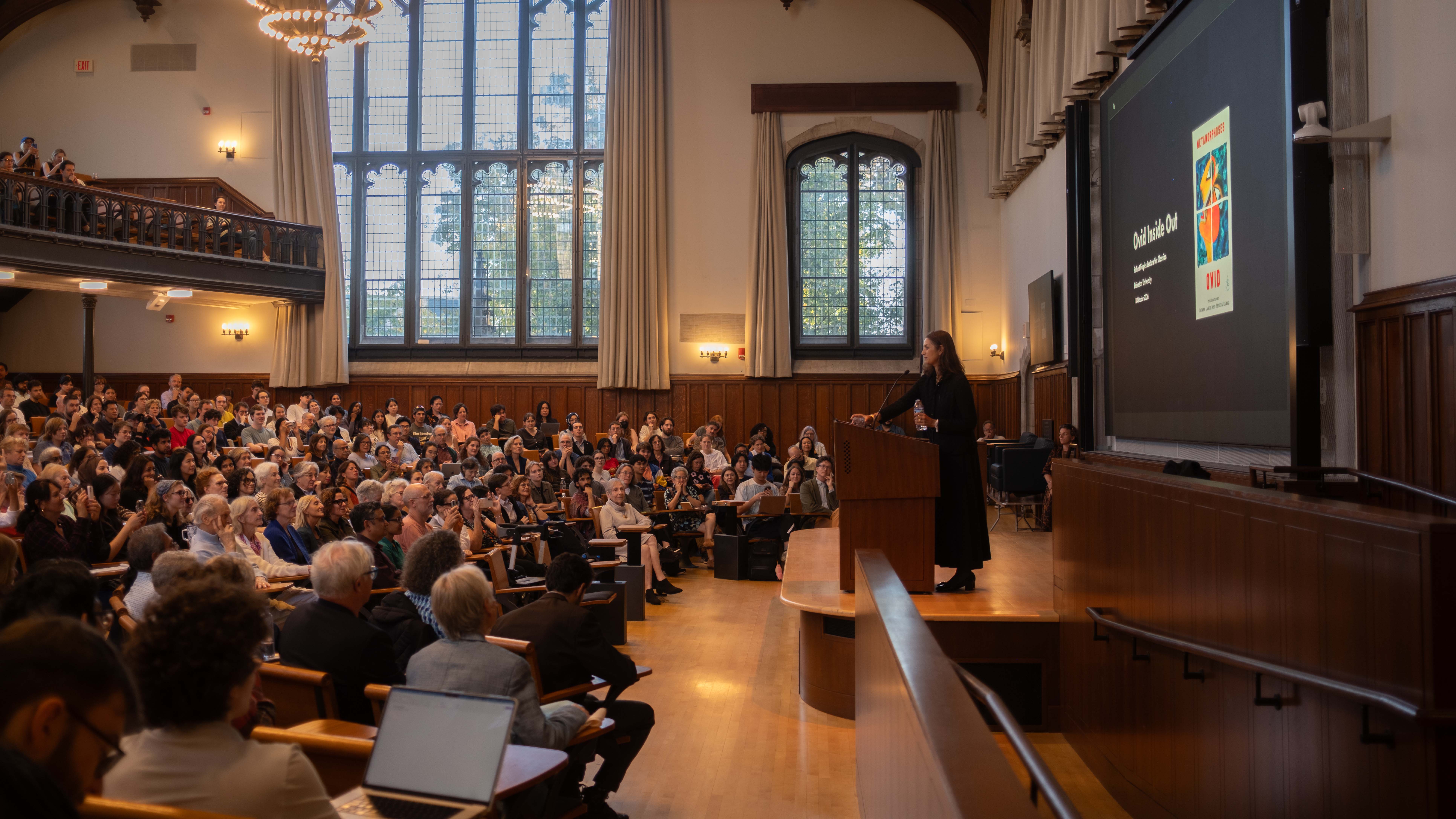
This was the question renowned writer and translator Jhumpa Lahiri explored in the 2026 Robert Fagles Lecture for Classics in the Contemporary Arts. For six years, Lahiri “lived inside” Ovid’s Metamorphoses, working alongside Kennedy Foundation Professor of Latin and chair of the Classics department Yelena Baraz on a new translation of the ancient epic, set to be published by Modern Library in May 2027. In the lecture, titled “Ovid Inside Out,” Lahiri reflected on the experience of translating the poem, and how it transformed her relationship with language, literature, and letting go.
“I am happy and humbled to be back at Princeton giving the legendary Robert Fagles lecture,” said Lahiri, who taught at the University as a professor of creative writing from 2015 to 2022. “My time [here] was profoundly transformative and it’s fitting to be here to discuss this work.”
Hundreds of attendees gathered in 50 McCosh for Lahiri’s talk, which unfolded in three parts: in, inside, and out. Lahiri began with “in,” the first word of Ovid’s poem, as an opening to discuss double meanings in the poem and the two worlds that translators must occupy in tandem.
Lahiri next took the audience “inside” her collaboration with Baraz, which began in the Princeton classroom when the pair co-taught an undergraduate Humanistic Studies seminar in 2020. Starting with the new translation’s first lines, written on Linden Lane in Princeton and in the Department of Classics’ Prentice Memorial Library, Lahiri described how the poem evolved alongside their own lives. “[The two of us] became something of a hybrid,” she said.
Baraz described the same partnership from the classicist’s side. “The collaboration flowed naturally from the teaching, which brought together my interest and sensibility as a scholar and her insight and sensibility as a writer,” she said. “Being constantly in conversation with each other in the classroom translated into continuing the conversation as we were working through the poem.”
Across such conversations, the pair “traversed the labyrinth” of the poem anew with each draft. At times, Lahiri said, it felt impossible to see a way through the translation, comparing the trickiest parts to “leaning into churning waves.”
In the lecture’s final section, Lahiri described learning her way “out” of Ovid’s world after six years of work, now that the book is nearly complete. “Though I have shed the labor of the Metamorphoses as a snake sheds its skin, the translation remains a transfusion: fresh blood to my heart and soul,” Lahiri said.
Now, as she prepares to share their Ovid with a new generation of readers, it seemed fitting that Lahiri gave the last word to someone else. Inviting her son, actor Octavio Lahiri Vourvoulias, to join her onstage, Lahiri looked on as he read a scene from the poem’s final book, when Aesculapius, son of Apollo and god of healing, departs his temple in Epidaurus for Rome.
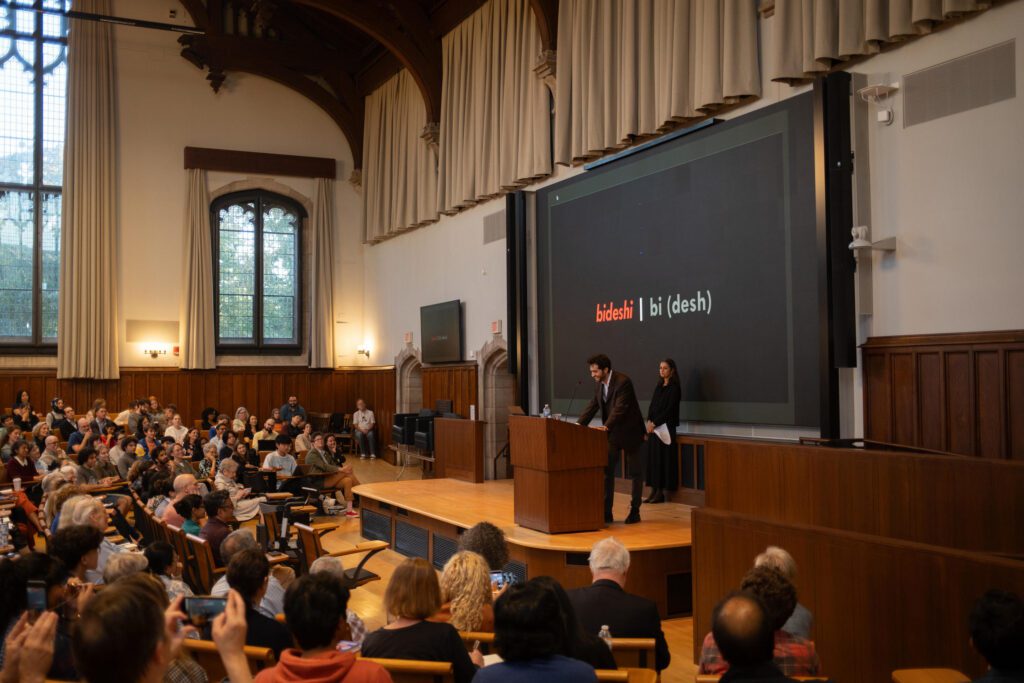
Lahiri’s visit continued a tradition now in its ninth year. Established in memory of classical translator and Princeton professor Robert Fagles, the Fagles Lectures have featured celebrated poets, novelists, translators, and playwrights including Alice Oswald, A.E. Stallings, Kamila Shamsie, Luis Alfaro, Daniel Mendelsohn, and most recently, Nobel laureate Anne Carson.
While on campus, Lahiri also returned to the familiar setting of 010 East Pyne to lead a session of the Humanities Sequence course “Interdisciplinary Approaches to Western Culture,” a course she taught in Fall 2021.
The lesson gave students the opportunity to enter Ovid’s poem themselves. Resuming her exploration of Ovid’s opening, Lahiri led students through the first four lines of Book 1 — the proem — as a fundamental passageway into the Metamorphoses. She examined the variety of ways that translators have interpreted the “forms” mentioned in the proem’s lines, drawing on translations by Rolfe Humphries, Allen Mandelbaum, Stephanie McCarter, and C. Luke Soucy, whose version students are reading in the course this year.
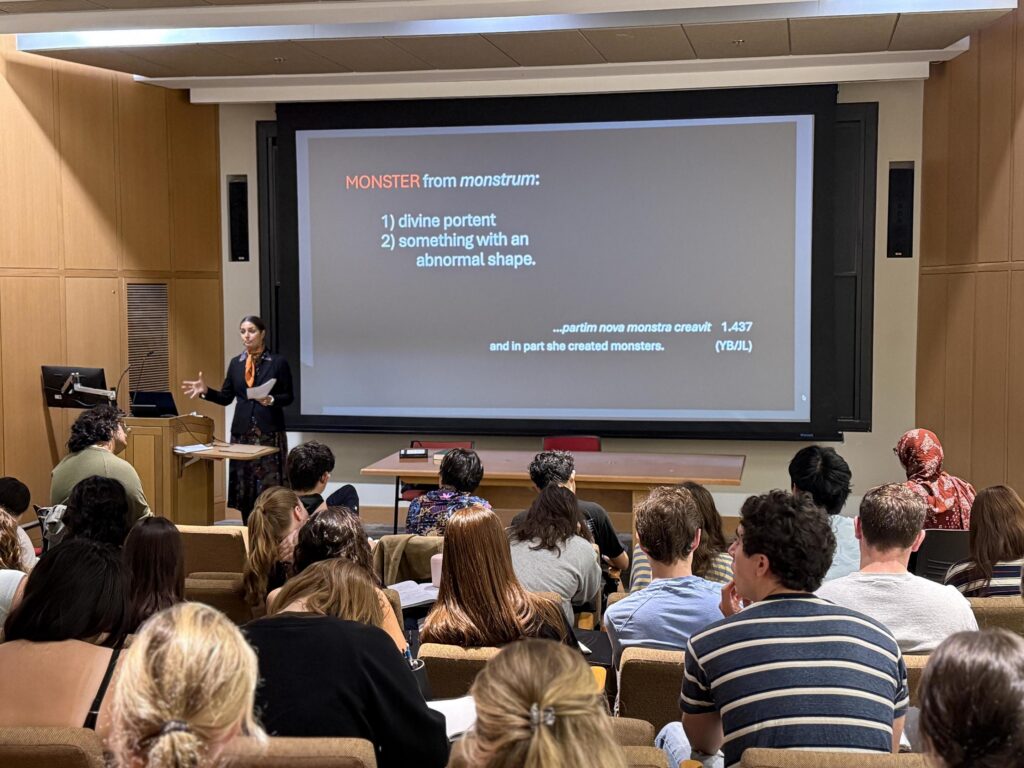
During a short Q&A session, Lahiri encouraged students to embrace the “monster” of literary translation, and to be willing to “deform and reform.”
Asked about the role of translation theory, Lahiri encouraged students to be open to learning terms and concepts, but not to bind themselves to any rule. “Translation is a work of art, a form of creativity,” she said. “There is no recipe for writing a poem or making a translation.”
Returning to the themes of her Fagles Lecture, Lahiri concluded her visit to the Western Humanities Sequence with inspiration for future translators in the room.
“Literature survives across time, in part thanks to the labor of translators,” she said. “You may have to unmake, remake, and make again. But even if you feel like the waves are about to swallow you, do not be afraid of the process.”
The Robert Fagles Lecture for Classics in the Contemporary Arts is supported by the Department of Classics, the Department of Comparative Literature, the Humanities Council, Princeton University Public Lectures, the Program in Humanistic Studies, and the Seeger Center for Hellenic Studies.